
Published by Sara Mahmoudi Rashid | ScienceDirect on March 9, 2024.
As global energy demand continues to increase, driven by widespread adoption of renewable energy sources, the challenge of integrating these dynamic and intermittent sources into electrical systems becomes increasingly evident. In response, a comprehensive examination is underway to leverage advanced control systems, energy storage technologies and renewable resources to strengthen the stability of power systems around the world.
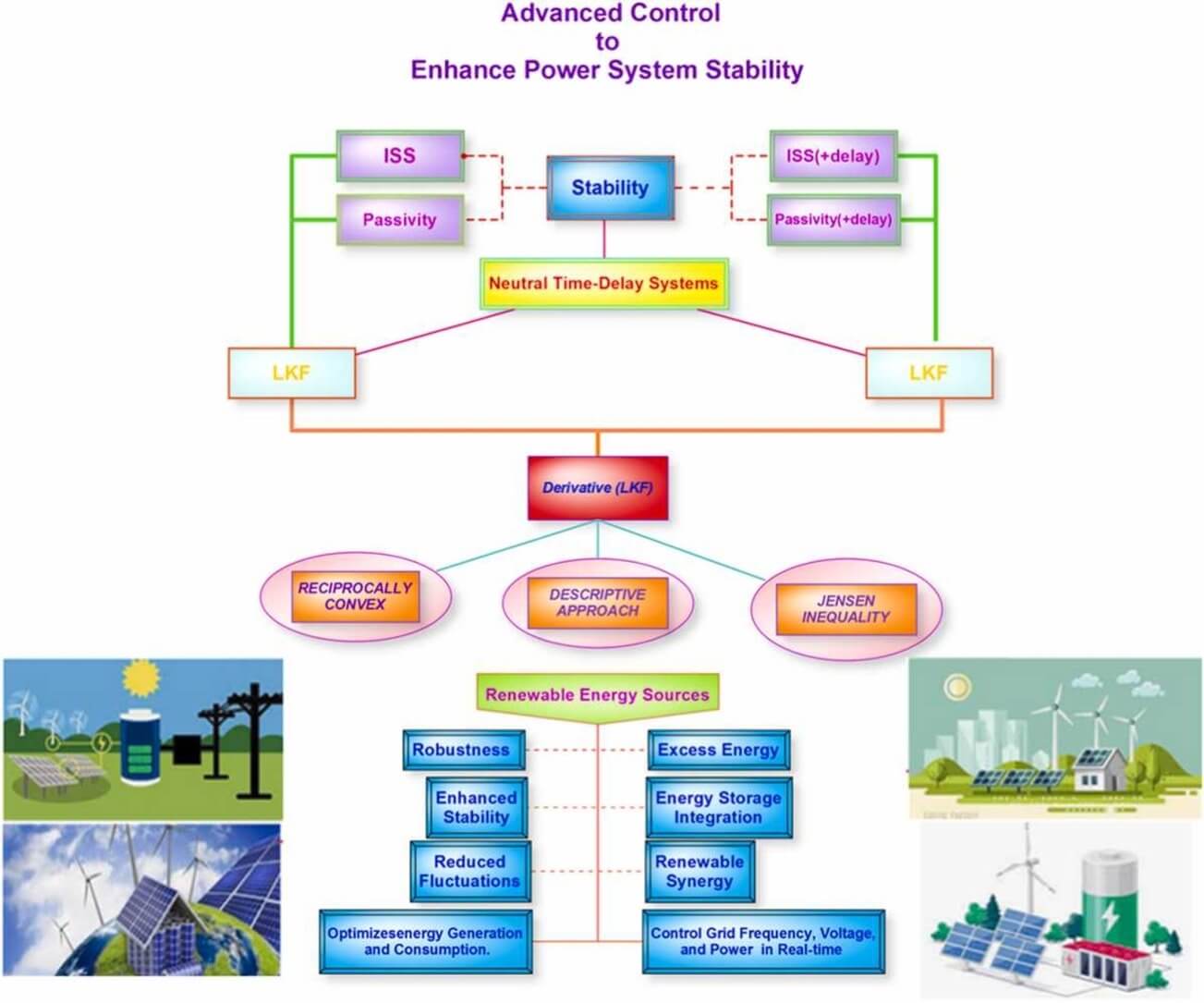
A recent study delves into the potential of integrating advanced control methodologies, energy storage solutions and the utilization of renewable energy to improve the reliability, predictability and sustainability of electrical systems. A key focus of the study is the meticulous analysis of stability, emphasizing in particular the entry-to-state stability (ISS), achieved by applying the Lyapunov function and the Reciprocal Convex Approach, resulting in an impressive rate stability of 23.6%.
Furthermore, the study validates Positive Reality by employing Linear Matrix Inequalities (LMI) within the framework of Improving Grid Stability with Wind Energy. Special attention is paid to the evaluation of ISS and Passivity in systems with both delayed and non-delayed dynamics, with specific emphasis on neutral time delay systems. This evaluation process involves the careful selection and derivation of an appropriate Lyapunov-Krasovskii Function (LKF), integrated with reciprocal convex methods, descriptive approach and Jensen's inequality.
The findings of these analyzes not only elucidate the causes of surplus energy and its efficient storage, but also highlight the synergistic benefits of integrating renewable sources while dynamically controlling grid frequency, voltage and power in real-time scenarios. . Furthermore, the study highlights the robustness achieved through Enhanced Stability and effective mitigation of Reduced Fluctuations, especially in the context of renewable energy sources.
In practical terms, the integration of advanced control, energy storage and renewable technologies promises to address the challenges posed by the intermittent nature of renewable sources within electricity systems. By strategically combining these elements, electrical systems can achieve greater resilience, reduced vulnerability to fluctuations, and improved overall performance.
The research underlines the importance of continued innovation and development in the field of power system stability, especially amid the accelerated transition towards renewable energy sources globally. The need for continued collaboration between researchers, industry players and policy makers is emphasized to implement strategies that optimize renewable energy integration while maintaining grid stability and reliability.
Going forward, the insights gained from this study are expected to inform the design and implementation of future electricity systems, paving the way towards a more sustainable and resilient energy landscape. As the world continues its march toward a greener future, advances in energy control, storage and renewable technologies will play a critical role in shaping the trajectory of global energy systems.


